.png)
 EN
EN
 ES
ES

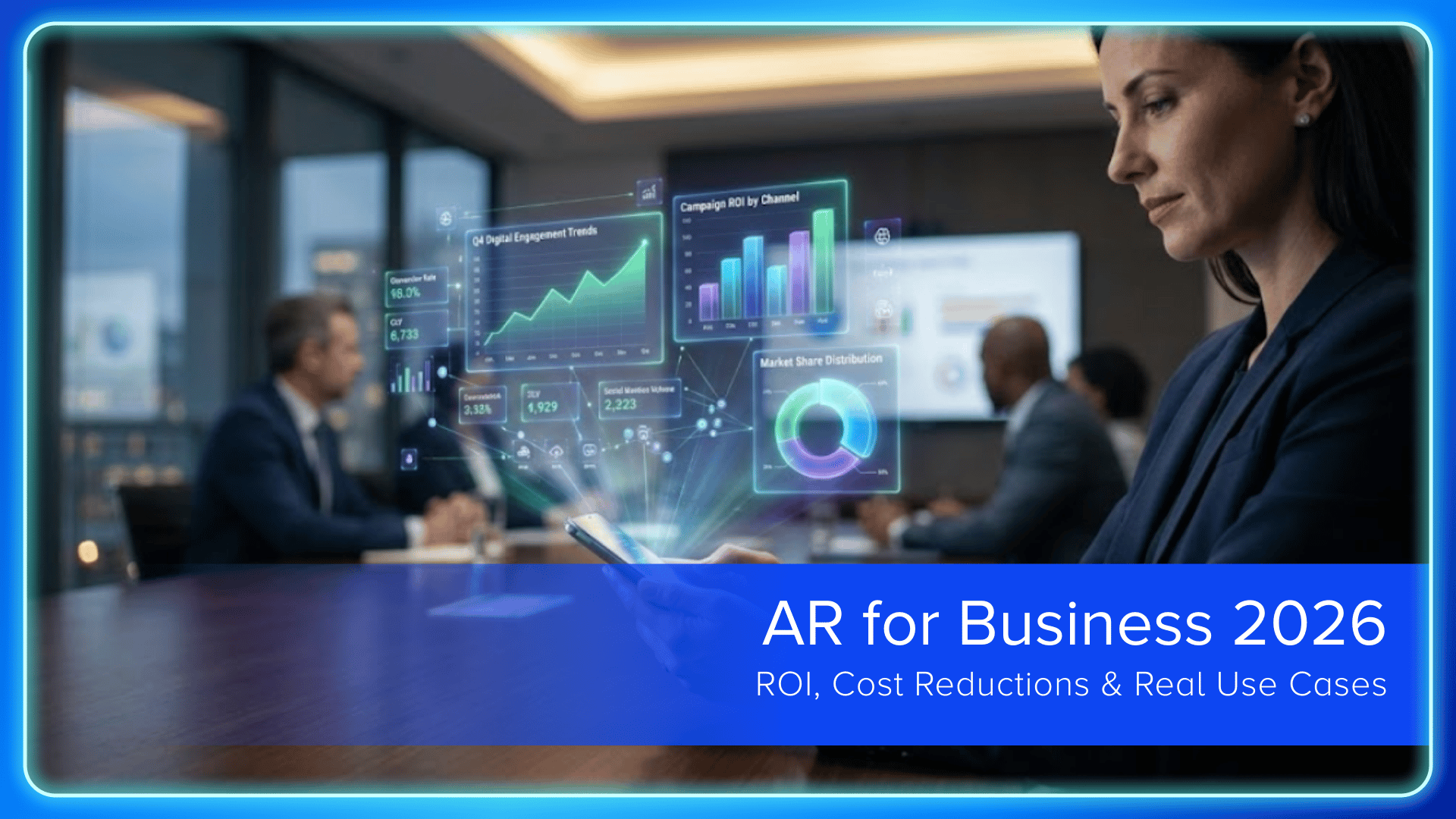
For years, companies poured massive budgets into static training manuals and traditional advertising. But let's be honest: the modern consumer and the modern workforce have become experts at ignoring passive content.
If you want to break through the noise in 2026, you need to invite users to be part of the story. AR for business is no longer just a futuristic gimmick; it is a proven strategy to reduce operational costs, boost your augmented reality for marketing campaigns, and drive measurable ROI. Let's look at how this technology is transforming key sectors.
Efficiency in Sales and Marketing Campaigns
The first major shift we see when implementing augmented reality solutions is the immediate change in audience engagement.
If you are wondering how can augmented reality improve retail customer experience, the answer lies in removing purchase friction and creating interactive touchpoints. But which AR software solutions are best for retail businesses? Custom WebAR solutions (which require no app downloads) are currently the most effective way to create frictionless, viral experiences.
Inmersys Portfolio Highlights: High-Impact Brand Activations If you are asking where can I find demos of AR tools for marketing campaigns, look no further than our work with global brands:
- AR Product Catalogs & Virtual Try-Ons: For luxury furniture brand Alfonso Marina, we developed an AR catalog that allows customers to visualize pieces directly in their physical spaces before buying, drastically reducing return rates. Similarly, our AR Smart Mirror for Pond's captures customer attention at the point of sale, proving how ar for retail boosts conversion rates without the need for physical sample inventory.
- Smart Packaging & Gamification: To celebrate a special edition tequila, we created the José Cuervo "Edición Xolo" (WebAR) experience. By scanning the bottle's label, consumers unlocked an interactive digital journey to the Mictlán. Similarly, with the BIC AR Lighters campaign, we transformed everyday items into portals for Mexican culture, where users interacted with 3D characters and trivia games. This strategy monetizes attention and builds massive brand loyalty.
Transforming Employee Training in Large Companies
The impact of AR goes far beyond the sales floor. When looking at how can AR improve employee training in large companies, the results are staggering. Interactive 3D modules allow employees to learn by doing safely, improving knowledge retention and reducing onboarding times by up to 40%.
A prime example is the AR Induction Process created for DHL. Instead of halting key operations to train new hires, DHL uses augmented reality to familiarize staff with complex logistics processes. This standardizes training and significantly lowers operational costs.
Success Cases in Industrial Sectors
In heavy industries, equipment downtime equals lost money. For operations managers trying to find AR solutions for remote assistance in field service, the ROI is immediate. A local technician can wear an AR headset and receive real-time, step-by-step holographic guidance from a remote expert while keeping their hands free.
The Hardware Landscape: AR Glasses vs. Mixed Reality
This brings up a critical hardware question: What AR hardware is recommended for industrial applications? To make a profitable decision, we must clarify the technology:
- Mixed Reality (MR) Headsets: Devices like the Microsoft HoloLens 2 and Magic Leap 2 use transparent lenses to project spatially-aware 3D holograms that blend with your real-world environment. They are the best AR headsets for enterprise use cases involving complex 3D engineering and heavy machinery manipulation. (Note: Devices like the Apple Vision Pro fall into the XR/Passthrough category, using opaque screens and cameras rather than transparent optical AR).
- Smart AR Glasses: The market has also seen a surge in lightweight AR glasses from brands like Vuzix, RealWear, or XREAL. These glasses focus on "assisted reality," projecting 2D data or video feeds directly into the worker's line of sight, making them highly cost-effective for daily logistics.
The True Cost: Custom Apps vs. Subscriptions
Finally, what are the top augmented reality platforms for business use and what are the leading AR platforms for industrial training? While third-party SaaS options exist, large corporations must compare costs of custom AR app development versus platform subscriptions. A premium custom AR app development requires an upfront investment, but it eliminates the scaling monthly licensing fees of SaaS platforms. A custom solution integrates perfectly with your existing ERP or CRM and belongs 100% to your company, maximizing your long-term ROI.
At Inmersys, we are experts in transforming physical operational challenges into unforgettable, highly profitable digital experiences. Contact us today, and let's design the next great AR solution that will leave your competitors behind.